
Leeds Visitor Economy Hits £3bn — But 2026 Is Proving Harder Work
Record 2025 figures were unveiled at a city briefing this week — alongside frank data showing conference bookings, hotel demand and delegate spend all under pressure in 2026.


Leeds welcomed 31.57 million visitors in 2025, generating £3 billion for the local economy and supporting 23,575 full-time jobs, according to STEAM figures presented at a Leeds visitor economy briefing on Monday. The city also hosted 33,200 conferences and events, welcoming 1.8 million delegates and adding £352.4 million to the economy. But the data specialists who shared the stage painted a more mixed picture of 2026 trading, with hotel supply outpacing demand and event bookings harder won than a year ago.
Inside the £3bn Leeds visitor economy
The 2025 headline numbers, from the STEAM economic impact model and the UKCAMS conference survey, confirm hospitality as one of the city’s biggest industries. Staying visits rose 3.6% year on year to 3.4 million, against a national backdrop of declining overnight trips, and West Yorkshire’s wider visitor economy reached £6.63 billion. Claire Heap, Visitor Economy Manager for Visit Leeds and Conference Leeds, told the briefing the sector has grown steadily over seven years, though the pace is now stalling, with economic value up 4%. Visit Leeds’ 2026 plans include a new website launching by the end of the year, a visitor profiling study with the University of Leeds targeting 15,000 visitors, a city marketplace, and campaigns built around the Christmas market and the Tour de France Femmes.
The 2026 numbers: fewer events, higher spend
The 2026 trading data for the Leeds visitor economy is more nuanced. Venue Directory reported confirmed Leeds bookings up 2% between January and August, with their value up 11% to £7.1 million and average spend per event at £28,000, though average attendance fell 10%. Venue Performance’s Peter Heath said Leeds venues saw four consecutive months of decline from May to August, erasing gains made earlier in the year, but noted the city’s food, drink and room-hire rates are growing 19% faster than the national average. STR put Leeds hotel occupancy at 74%, in line with a stabilised UK market, and expects another year where growth comes from rates rather than volume. Expedia’s Beth Brogan-Steel was blunter, describing a market with more rooms than demand, driven largely by domestic travel with China, the USA, Norway and Germany the biggest international sources. Peter Heath added that Leeds stands out for how collectively its venues work to win business for the city, a culture he said is matched only by Manchester.
 Retail and leisure
Lano Noodles to create up to 10 jobs at Merrion Centre
Lano Noodles will open its first restaurant on Merrion Way opposite the first direct bank arena, taking 2,150 sq ft and creating up to…
A.MacGregor · 6 Nov 2026 Retail and leisure
Joe & The Juice takes 3,595 sq ft for first Leeds store
Danish juice and coffee chain Joe & The Juice will open its first Leeds store in a 3,595 sq ft unit on Trinity Street…
A.MacGregor · 2 Nov 2026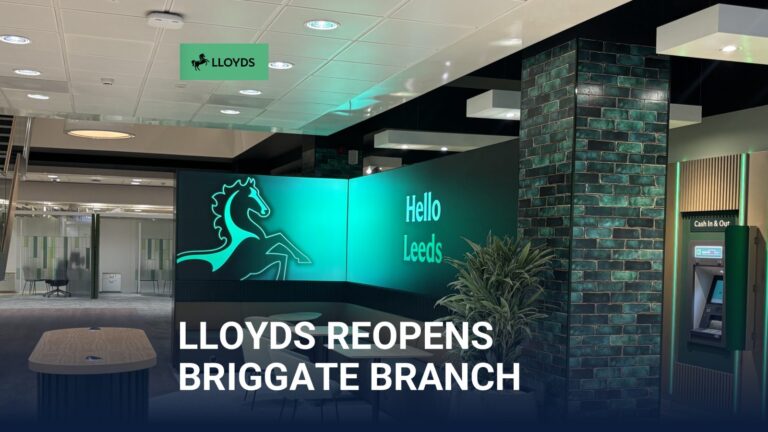 Retail and leisure
Lloyds reopens Briggate branch after £1m refurbishment
Lloyds has reopened its Briggate branch in Leeds city centre after a £1 million refurbishment, with new meeting spaces and business banking machines.
A.MacGregor · 2 Nov 2026