








































Guest Author

Melissa Hendry
The Operating Co.Melissa Hendry is the founder of The Operating Co, providing fractional COO and operational support to scaling technology businesses. With more than 22 years of experience, she has helped technology and digital businesses grow from early-stage teams into multi-million-pound operations, co-founding and scaling businesses to £10m+ revenue and helping build international teams of 160+ people. She now works with founders and leadership teams to strengthen execution, financial oversight, delivery and operational clarity.

Never Miss a Leeds Business Event
Get our monthly events guide straight to your inbox — every networking meetup, conference, and showcase happening in Leeds.
Plus the weekly Leeds Business Briefing every Wednesday.
Free, no spam. Unsubscribe anytime. Privacy policy
In the early years, speed, instinct, energy, and the ability to make fast decisions while staying close to everything are exactly what gets a business moving.
But as the business grows, those same habits can start to create strain, both personally and for your team.
If the structure and ways of working that helped build the business do not evolve at the same pace, this is often where founders and the wider business start to feel the pressure. .
It is more common than many Leeds business leaders may think. Having co-founded two tech businesses and spent more than two decades inside scaling tech companies, I have seen the same challenges surface, often around the £2m, £5m and £10m revenue marks. Usually, it is a sign that the company has grown, but the way it operates has not fully evolved with it.
The warning signs business leaders might recognise:
1. Key decisions still come back to you: Budgets, contracts, priority calls, proposals or client issues all wait for your input or sign-off. It can feel like you’re maintaining standards or minimising risks, but it often slows down progress, can unintentionally signal a lack of trust in your team, and growth becomes capped at the speed of your decision-making, often under pressure and without full context.
2. Your senior people have titles, but not ownership: You hired experienced people to lead, but they can feel left to execute decisions they did not make or may not fully support. If most decisions still sit with you, your leaders get stuck in the day-to-day and stop feeling the value of their experience is being used. Eventually, many leave for somewhere they can lead, grow and feel valued.
3. Departments make decisions in isolation: A new idea gets prioritised without assessing the cost or wider impact. Tech is prioritising technical debt over a feature the business is expecting to launch. Marketing is about to release a campaign that product or delivery is not aware of. Sales commits to something the team cannot yet fulfil, and HR has no hiring forecast for that quarter. Everyone is busy, but not working to the same assumptions, or priorities. This is where margin leaks, client expectations slip, orders are lost, and teams end up absorbing the consequences.
4. You lose good people: You spend time and money finding the right people, they arrive full of energy, yet leave burnt out, disengaged or saying it wasn’t the right fit. This can happen when pressure, unclear ownership, poor cross-functional alignment, or gaps in process or tooling become part of the day-to-day experience. I’ve seen businesses lose 37 people, including senior leaders, over a two-year period because issues like these were left unresolved for too long.
5. The pressure becomes harder to hold: For many leaders, this does not come from a lack of care. It comes from caring deeply, wanting things done properly, and carrying too much for too long. Sleep suffers, health gets pushed down the list, and there is little time or headspace left to step back and work out what really needs to change. When everything feels urgent, that pressure can start to show in a late-night email, a sharper message, or a conversation that carries more frustration than clarity. The answer is not to care less or push harder. It is to change the structure that is asking one person to hold too much.
6. Information is inconsistent or unclear: Information is not coming through in a timely or coherent way. When updates are inconsistent or lack context, it becomes much harder to make fast, confident decisions and to sleep at night.
Why this matters commercially:
According to the ScaleUp Institute’s 2024 report, fewer than 0.6% of UK SMEs achieve sustained high growth, yet those businesses generate around half of all SME turnover combined. Scaling is rare, but for the businesses that get it right, the commercial upside is disproportionate.
How to scale, effectively:
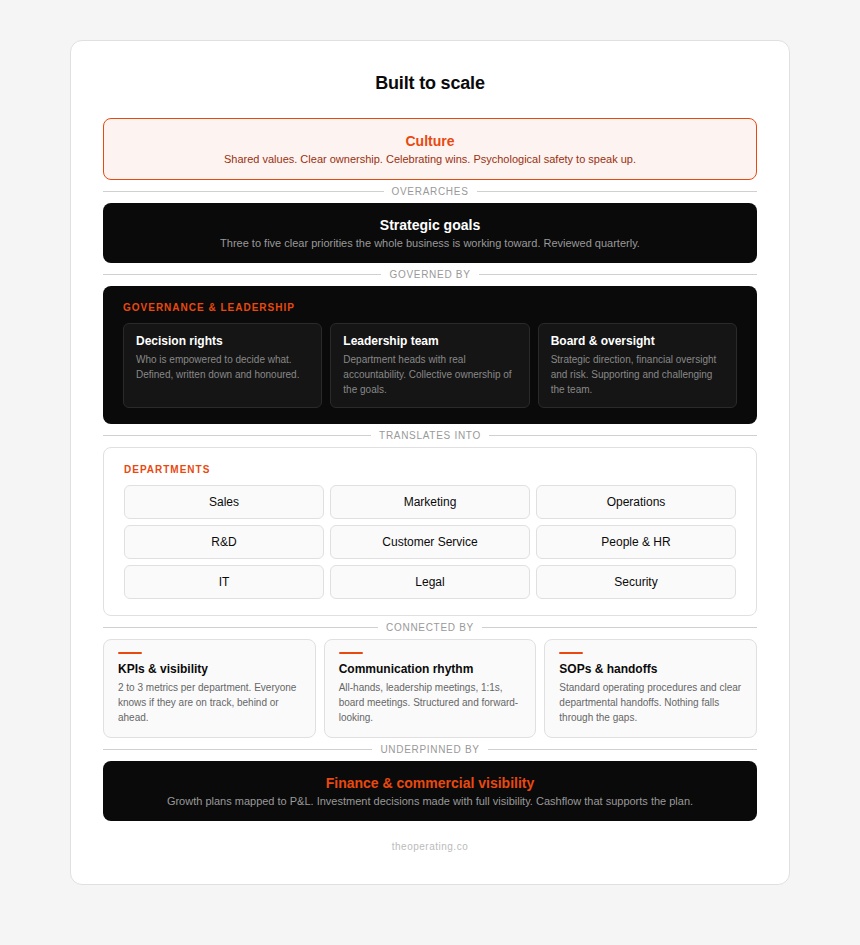
Fixing this properly takes more than one honest conversation with your team. In most cases, it needs a clear operational plan: a practical 12-month view of what the business is trying to achieve each quarter, how each function contributes, where ownership and accountability sit, what people, systems, or investment are needed, and how progress will be measured and reviewed. Done well, it removes blockers, turns growth from a set of ambitions into something the business can actually deliver against, and something you can sign off and trust.
Here’s how to get started:
If you are not ready to build the full plan yet, these four steps are a useful place to begin. They will not solve the whole problem on their own, but they will help surface where the pressure points are and make it easier to see where change will have the biggest immediate impact.
1. Get radically honest feedback: Ask your team what’s working, what isn’t, what they need, and where decisions stall. Don’t take this personally, but allow people to speak freely, openly and ideally anonymously if you want to get to the root issues, and likely some great ideas that make a difference to your teams day-to-day.
2. Set clear company objectives: Clarify the key business growth drivers for the next 12 months, ideally between three and five, depending on the size and complexity of your business. That might be growing revenue in a specific target, improving margin, launching a new product or feature, or entering a new market. When these are clear and shared, every department can align decisions against them rather than optimising for their own priorities.
3. Make accountability visible through a plan: Each department head should come back with a plan for how they will deliver against it. This should include quarterly objectives, key changes needed, dependencies, support required, key hires, how progress will be reported, and critically the cost to deliver it.
4. Bring in a mentor or external help: Often, the issue is not effort, it is perspective. When you are deep in the day-to-day, it is hard to see what good looks like, where the real blockers are, or what to change first. The right external support or NED can help you challenge assumptions, bring structure to the problem, and help you feel less alone in working through it.
Closing.
The real challenge in growth is not just getting bigger. It is making sure the way the business runs can keep up and keep founders forward-facing. The businesses I’ve seen handle growth well are usually the ones that recognise early when the way they operate needs to evolve. Clearer priorities, stronger accountability, better alignment and the right structure do not remove every challenge, but they make growth far more manageable. In my experience, the cost is not in making that shift. It is waiting longer than you needed to
Why this matters for Leeds
Leeds is home to a fast-growing community of ambitious founders and scale-ups — many of them navigating exactly the inflection point Melissa describes. The ScaleUp Institute consistently identifies Yorkshire as one of the UK’s highest-potential regions for scaling businesses, yet the structural and leadership challenges that stall growth are rarely discussed openly.
- Learn more about The Operating Co: https://www.theoperating.co/
- Download the ScaleUp Institute 2024 analysis here.